

Study Undergraduate
The Undergraduate Program in Architecture at NTUT centers on architectural design, emphasizing a balance between theory and technology. The program aims to cultivate future architectural talent equipped with creativity and professional practical skills.
The curriculum encompasses professional courses in architectural history and theory, digital and engineering technologies aligned with international trends, and design studios connected with industry practices. Instruction utilizes a small-group teaching model and a rigorous review (critique) system to strengthen students' comprehensive abilities in conception, expression, collaboration, and critical thinking.
To deepen the breadth of learning and international perspective, fourth-year undergraduate students are permitted to select graduate-level courses, and the department offers multiple courses taught in English. We actively encourage students to participate in domestic and international competitions, design-build projects, site-based collaborations, extramural projects, and international exchange to expand their practical experience and global vision.
The advantage of being located in the heart of the Taipei metropolitan area provides the department with abundant external resources and industry connections. This, combined with the regularization of international exchange and a diverse student body comprising international students, offers an excellent environment for students to build their portfolios and professional expertise in real-world contexts. The department utilizes a clear Curriculum Map to help students systematically plan their course selection, competitions, and internships, thereby laying a solid foundation for future engagement in fields such as architecture, urban design, landscape architecture, or academic research.
Four-Year College of Technology
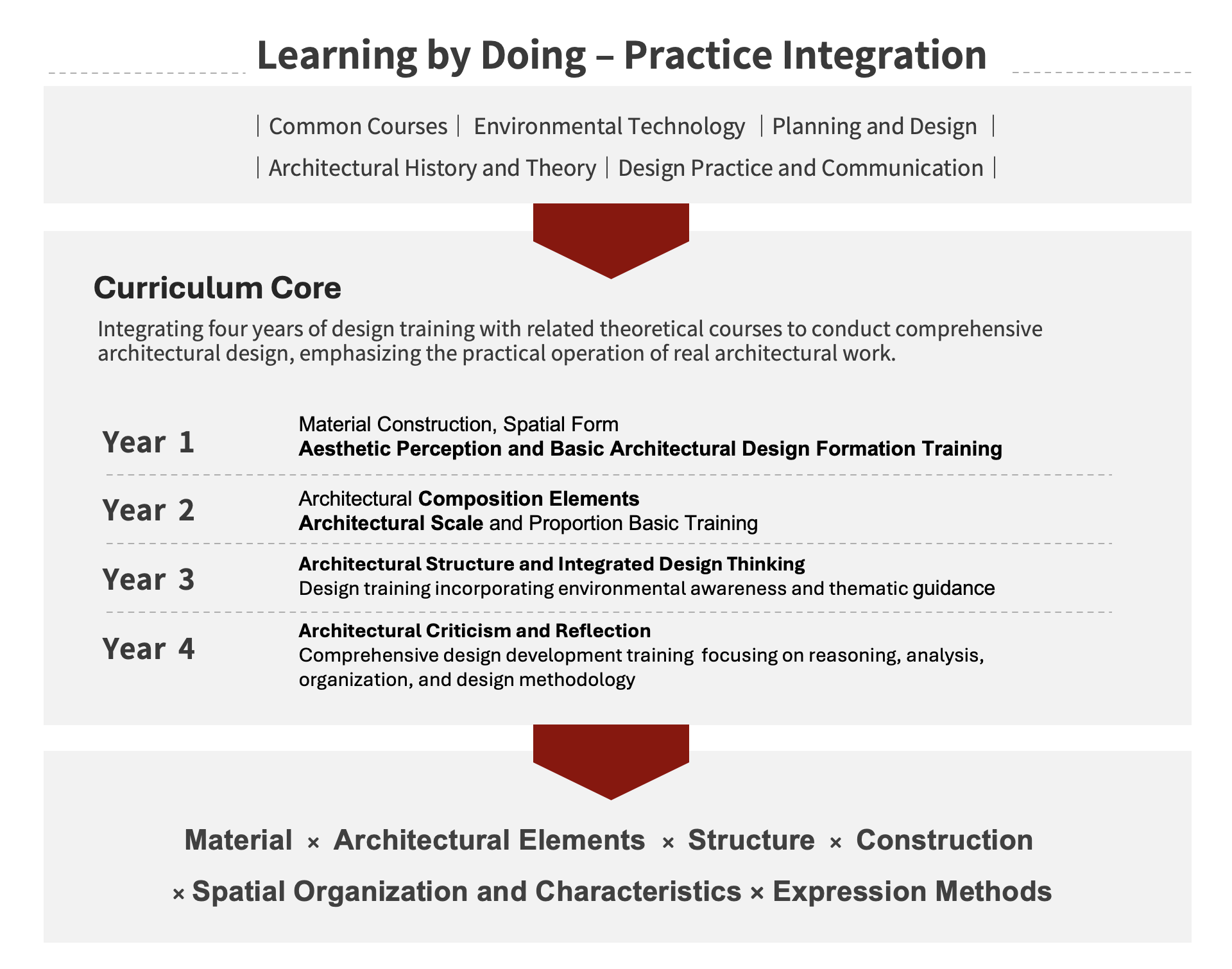
The Undergraduate Program in Architecture at NTUT operates as a four-year degree program within the Day Division, adhering to the educational philosophy of "integrating learning and application" (學用合一) and emphasizing professional training that balances design and technology.
The curriculum is structured for vertical integration, covering core subjects such as construction methods, materials and equipment, environmental control, digital modeling, and sustainable and healthy building practices. Teaching is continuous throughout the four years, using design critiques and extramural internships to systematically cultivate students' integrative abilities—from conceptualization to practical realization. This approach integrates interdisciplinary knowledge, including architectural history and humanities, structural systems, environmental control, and sustainable design.
The department places particular emphasis on strengthening industry linkages and employment internships. Through active participation in practical projects and design competitions, students develop essential on-site problem-solving skills and professional ethics, culminating in a complete skillset that spans from concept development and technical execution to proposal finalization.
Graduates possess a solid foundation in design conceptualization, professional ethics, and creative practical ability. They are well-prepared to either seamlessly transition to graduate-level studies or directly enter the architecture and related industries, becoming highly competitive professionals.
Curriculum Map
Related Courses Overview.